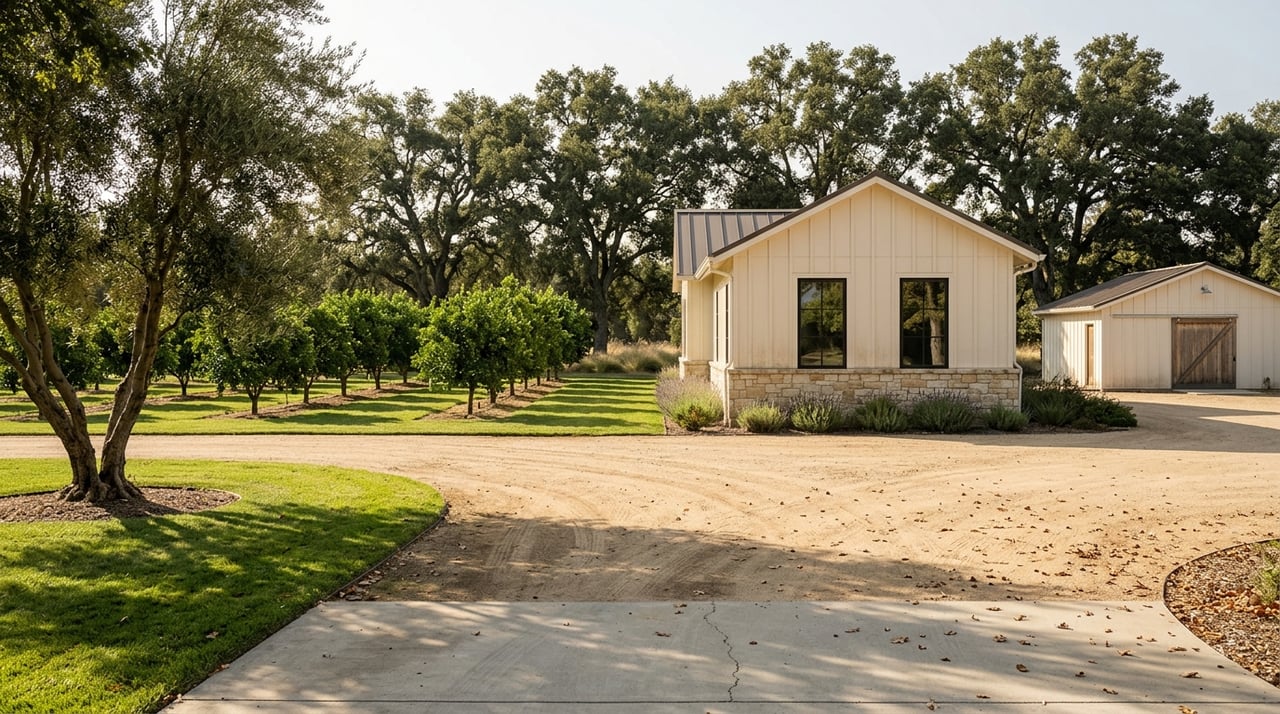
Drive down Taylor Road past the old orchard rows and you'll pass a $450,000 fixer on a quarter acre within a mile of a $1.2 million estate on five acres with a view of the Sacramento Valley. Both are technically "Newcastle." Neither one tells you much about the other. That's not a fluke of a small market. It's the market.
Newcastle sells somewhere between 15 and 25 homes a year across the entire community, and the price range in 2026 runs from roughly $400,000 for an older, smaller home along Taylor Road to well over $1 million for a custom estate on five-plus acres with panoramic valley views. When a market that thin has that much spread, the median stops meaning anything useful to an individual buyer or seller. You can't point to "the Newcastle number" the way you can in a subdivision with a hundred nearly identical homes. Every parcel is its own case study.
So if the comps won't tell you what a Newcastle property is actually worth, what will?
In most of these transactions, the answer sits underground. The well and the septic system, not the square footage or the view, are what separate a home that closes smoothly from one that stalls in escrow or gets repriced after inspection. This is the piece almost nobody explains clearly before an offer goes in, and it's the piece that decides whether the number on the listing holds up.
Why the Comps Break Down Here
Every neighborhood has some price variation. Newcastle's is structural. The community sits along a winding stretch of Taylor Road that connects to Auburn-Folsom Road and Highway 193, with freeway access at the I-80/Newcastle Road interchange. That access pattern, combined with a mix of century-old orchard parcels and newer estate-scale acreage, means two homes ten minutes apart can differ in lot size, water source, waste system, and buildable land in ways that no automated valuation model captures.
Add the low sales volume and you get a market where the usual pricing shortcuts don't hold:
| What buyers assume drives price | What actually drives price in Newcastle |
|---|---|
| Recent comps in the immediate area | Comps from parcels with genuinely similar acreage, access, and systems, which may be miles away |
| Price per square foot | Well yield, septic capacity, and how much of those costs a buyer will absorb |
| Listing photos of the view or the kitchen | The permit history sitting in a file at Placer County Environmental Health |
| Days on market | How long it took the seller to assemble well and septic records in a market with few recent transactions to reference |
None of this means Newcastle is a risky place to buy. It means the risk lives in a different place than most buyers are looking.
The Well Half of the Equation
If a Newcastle property isn't on a public water system, the well isn't a footnote. It's the water utility for that household, and it comes with its own paper trail.
Placer County requires that new wells be drilled only by a licensed C-57 well driller, and the application has to include a site plan showing the well's distance from anything that could contaminate it, including septic systems, sewer lines, and animal areas within 150 feet. For an existing well on a property you're considering, the equivalent due diligence is a four-hour well yield test and a bacteriological water sample tested for Total Coliform, E. coli, and chlorine residual by an ELAP-certified lab. A one-time water sample tells you the water is currently safe to drink. It tells you nothing about whether the well can keep up with a full household during a dry August. The yield test is the one that actually answers the question a lender or a buyer needs answered.
Newcastle's agricultural history adds a wrinkle worth knowing about before you assume there's just one well on a property. Parcels along the Placer County Wine Trail and the older orchard land that gave Newcastle its annual Mountain Mandarin Festival in November sometimes carry a separate irrigation well alongside the domestic well. If you're evaluating acreage with existing vines or fruit trees, confirm in writing which well serves the house and which one serves the land. They are not interchangeable, and a strong irrigation well says nothing about whether the domestic well will support the house.
The Septic Half of the Equation
According to KDS Homebuyers, Placer County requires septic systems to be evaluated or permitted through the local Environmental Health department at the point of sale. The county's Environmental Health division maintains an Operation, Maintenance and Monitoring program for septic systems, with real setback requirements between the leach field, the septic tank, the repair area, and any structure, pool, pond, or second driveway you might want to add later. Before you assume a property has room for a pool or a detached shop, check where the county's on-site sewage disposal setbacks land on that specific parcel. It's a five-minute call to the district specialist, and it can save you from designing a backyard around a leach field that isn't actually where you think it is.
Two local businesses show up repeatedly in these transactions. Sierra Septic Service and Supply, based in Newcastle, performs septic inspections specifically for home sales in addition to routine pumping and repair. RVC Pumping & Septic LLC, now based in Placer County, works across Newcastle, Penryn, Loomis, and Granite Bay and is staffed with NAWT-certified inspectors trained specifically in onsite wastewater systems. Either of these is a more useful starting point than a generic home inspector when the question is specifically "how old is this system and how much life does it have left."
A Due Diligence Sequence That Actually Matches This Market
If you're seriously evaluating a Newcastle acreage property, this is the order that protects you, not the order most buyers default to:
- Pull the septic permit file from Placer County Environmental Health before you write the offer, not after. It shows system type, rated bedroom capacity, and inspection history.
- Confirm which well serves the house if the parcel has agricultural or orchard history, and get that in writing from the seller.
- Order a four-hour well yield test, not just a water quality sample.
- Get the bacteriological panel (Total Coliform, E. coli, chlorine residual) from an ELAP-certified lab.
- Ask for the most recent septic pump receipt and review the septic records, especially if a past owner added a room.
- Verify well-to-septic setback distances against county code if anything on the site plan looks tight.
None of these steps require an aggressive buyer or a difficult seller. They require asking for documents that already exist and ordering two tests that most buyers skip because they assume a passing home inspection covers it. It doesn't. Standard inspections rarely include a full well yield test or a septic scope.
What This Means If You're Selling
The same logic runs in reverse. A seller in Newcastle who assembles the septic permit history, a recent pump receipt, and a current well yield test before listing is handing a buyer the exact documentation that would otherwise slow down escrow. In a market with this few transactions to lean on for reassurance, a clean paper trail on the well and septic system does more to justify a price than another round of comps ever will. It's also one of the few variables in a Newcastle sale that a seller can actually control before the property hits the market.
Frequently Asked Questions
Does Placer County require a septic inspection before a home can be sold? Placer County requires septic systems to be evaluated or permitted through the local Environmental Health department at the point of sale. Confirm the specific requirement for the parcel with the county before assuming either way.
What happens if a well doesn't produce enough water? This is exactly what the four-hour yield test is designed to catch before you're committed. A low-yield result doesn't automatically kill a deal, but it does become a negotiating point, and it's far better to know the number before removing contingencies than after.
Can you add bedrooms to a Newcastle home without touching the septic system? Check the existing system's capacity before planning an addition.
If you're weighing a Newcastle acreage property, or trying to figure out what your own well and septic paperwork actually says about your home's value, a conversation before you list or write an offer saves time later. Samantha Gray works Placer County's acreage and land transactions regularly and can walk through what a specific parcel's systems and permit history mean for your price and your timeline. Schedule a Consultation to start that conversation.
This article is general information, not legal, tax or financial advice. Consult a qualified professional about your situation.