Pull up five real estate sites for Loomis homes in the same week and you'll get five different stories about what a house here costs. One shows prices falling. Another shows them up more than 20 percent. A third puts the town's typical home near $950,000, a fourth near $1.6 million. None of these sources made an error. They're each looking at a real slice of Loomis. The problem is that Loomis doesn't have one housing market to measure. It has two, stitched together under a single zip code, and the "median" keeps sliding depending on which one happened to sell that month.
For a buyer comparing Loomis against Rocklin or Granite Bay, that matters more than it sounds like it should. A median price is supposed to be the one number you can trust when everything else about a market feels noisy. In Loomis, it's the number least worth trusting on its own.
Same Source, Same Month, Two Different Numbers
The clearest version of this shows up on a single site. In August 2025, the city-wide Loomis page reported a median sale price of $715,000, down 2.7 percent year over year, on a small number of closed sales that month. The same site's own Downtown Loomis neighborhood page, covering the same month, reported a median of $591,000, up 21.9 percent year over year. Same source. Same window. A $124,000 gap between "Loomis" and "Downtown Loomis," moving in opposite directions.
Zoom out and the spread only widens. By June 2026, that same city-wide page put the Loomis median at $727,104, up 20.2 percent year over year. A mid-year 2026 report built from closed MLS sales across the region put the Loomis median at $950,500 for the first half of the year, down 3.9 percent year over year, but with sales volume up 19.3 percent to 68 homes and price per square foot up 3.2 percent to $476, the strongest gain of any market that report tracked. Listing-side data tells yet another story: active listings priced around a $1.6 million median in spring 2026, then around $1.45 million by August 2026, both with a price per square foot near $526.
| Source and window | What it measured | Reported figure |
|---|---|---|
| City-wide, closed sales, Aug 2025 | Median sale price | $715,000 (down 2.7% YoY) |
| Downtown Loomis only, closed sales, Aug 2025 | Median sale price | $591,000 (up 21.9% YoY) |
| City-wide, closed sales, June 2026 | Median sale price | $727,104 (up 20.2% YoY) |
| Regional MLS report, closed sales, H1 2026 | Median sale price | $950,500 (down 3.9% YoY) |
| Average home value index, July 2026 | Average value | $962,909 (up 2.2% YoY) |
| Active listings, spring 2026 | Median list price | $1.6M |
| Active listings, Aug 2026 | Median list price | $1.45M |
None of these numbers is a typo. They're each accurate descriptions of whatever homes actually traded or listed in that window. The reason they disagree this much is that Loomis's own zoning code manufactures two very different products under one town name, and a market this small can flip between them from one month to the next.
The Zoning Line That Splits the Town
Loomis's municipal code draws a hard line between two residential zones, and that line is what's actually generating the price spread.
The RS zoning district covers single-family neighborhoods, and its density ranges from one home per half acre up to two to six homes per acre depending on the specific parcel. The densest version of that district, RS-5, the one that allows the smallest lots, is applied only within the downtown area of Loomis. That's not a general suburban standard. It's a deliberately narrow carve-out for one part of town.
Everywhere else, the Rural Residential district takes over, and it works in the opposite direction. The code sets a maximum density of one dwelling per acre in RR zones generally, and it gets even more specific along two roads in particular: new subdivisions along the Barton Road and Rocklin Road frontages must provide a minimum of 4.6 acres per parcel, or 2.3 acres if the parcel sits away from those roads.
Put those two rules side by side and you can see exactly why "Loomis" isn't one thing. The smallest, most affordable lots the code allows are legally confined to a small downtown footprint. Everywhere outside it, the same code pushes toward acreage, sometimes several acres, per home. A buyer searching "Loomis homes" is really choosing between two different zoning worlds that happen to share a mailing address.
What Each Side of That Line Looks Like
Downtown Loomis is the smaller-lot side of the code in practice. Homes there sell faster and cheaper than the town-wide averages suggest, which is exactly what that August 2025 neighborhood figure was picking up. It's walkable to the town's older commercial core, and it's the part of Loomis where the zoning code deliberately allows more density.
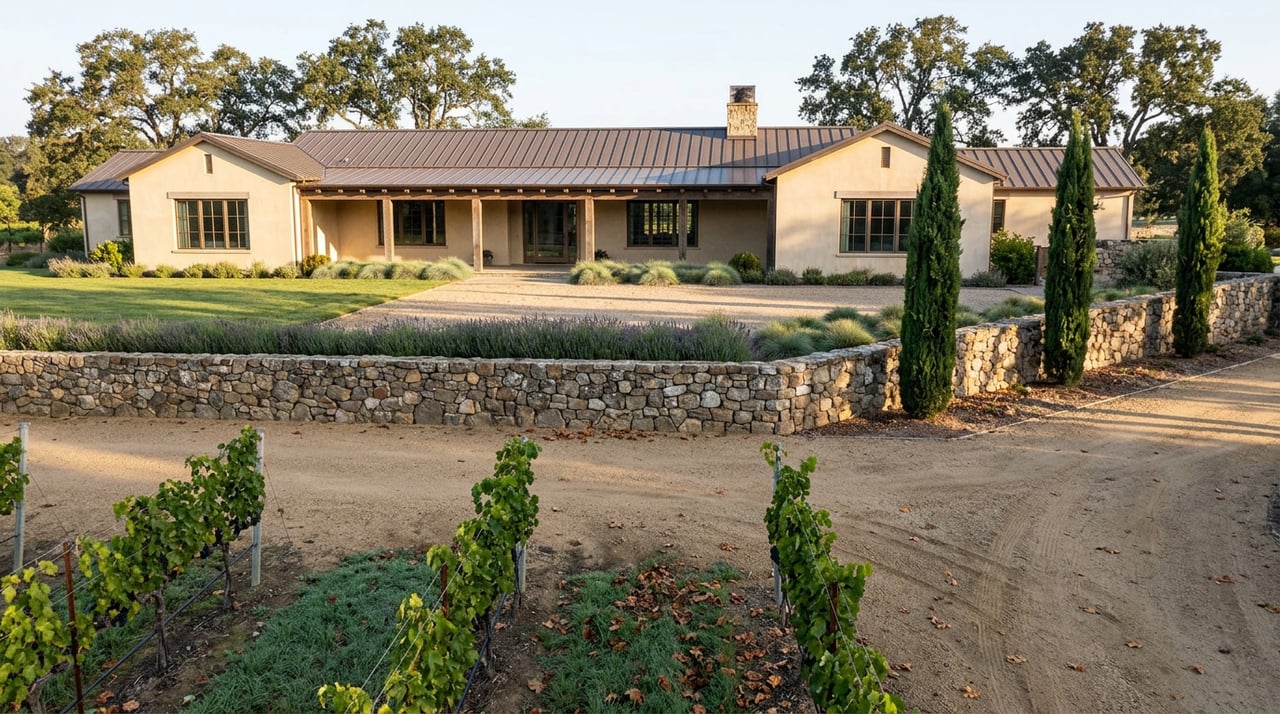
Drive a few minutes outside that footprint and you land in the acreage side of the ledger. Clos du Lac is a gated community of 88 homes built around more than 20 acres of vineyard that the homeowners association manages collectively, with grapes sold to area wineries including Casque Wines and Lone Buffalo Vineyards. Individual home sites there range from about a third of an acre up to 27 acres, and homes span from roughly 2,200 to over 11,000 square feet. That's not a rounding difference from a downtown cottage lot. It's a different category of property governed by a different section of the same zoning code.
Sierra de Montserrat sits further into the RR side of that line: a private, gated community of 62 custom homesites spread across 322 acres of foothill terrain, with roughly 200 acres set aside for oak woodland and wetland conservation and a working vineyard woven through the rest. Recent homesite parcels there have run from about 4.6 acres up to 5.5 acres and beyond. A house in Sierra de Montserrat and a house in Downtown Loomis can both be described as "a Loomis home," and both descriptions are accurate. They're just not describing anything close to the same market.
That's the mechanism behind the swinging median. When a month's closed sales lean toward the downtown side of the code, the reported number drops. When they lean toward the acreage side, whether it's a Clos du Lac vineyard estate or a Sierra de Montserrat custom build, the number jumps. With so few sales closing in a typical month, it doesn't take many acreage sales to swing the whole town's reported median by six figures.
The Signals That Move More Slowly
If the median is this sensitive to which zoning pocket happened to sell, it's worth asking what actually holds steady. The mid-year 2026 MLS report offers a better answer than the median itself: price per square foot rose 3.2 percent to $476 across the first half of 2026, the strongest gain of any Placer-area market it tracked, even as the median dipped. Buyer competition told the same story. Loomis buyers averaged 2.5 offers per home in that period, the highest average of any market in the report, and 38 percent of sales closed above list price. Sales volume itself was up 19.3 percent to 68 closed transactions.
Those figures don't bounce around the way a six-month median can, because they're not as easily distorted by whether a handful of vineyard estates or downtown cottages happened to close in a given quarter. Price per square foot and offer count are measuring demand pressure directly. The median is measuring demand pressure filtered through whatever mix of lot sizes traded that month.
What This Means If You're Comparing Neighborhoods
If you're weighing Loomis against Rocklin or Granite Bay using a single headline price, you're comparing an unstable number to markets with far higher transaction counts and more consistent lot sizes. The fairer comparison starts one level down: ask which zoning pocket of Loomis actually matches what you're shopping for, and evaluate that pocket on its own terms.
For a downtown-style purchase, look at days on market and price per square foot within that footprint specifically, not the town-wide figure. For an acreage purchase, treat comparable sales as genuinely comparable only when the lot sizes and zoning designation line up, since a 2.3-acre parcel and a 4.6-acre parcel under the same RR code can carry very different development and resale considerations. And for any number you see quoted for "Loomis" as a whole, the useful question isn't whether it's accurate. It's what mix of homes it happened to be built from.
That distinction is the kind of thing that only becomes clear when you've watched enough closings move through both sides of this town to see the pattern repeat. If you're weighing a move to Loomis, or trying to figure out what a specific number you saw online actually represents, Samantha Gray can walk through the current inventory on both sides of that zoning line with you. Schedule a consultation to talk through what your budget actually buys here, and where.
This article is general information, not legal, tax or financial advice. Consult a qualified professional about your situation.