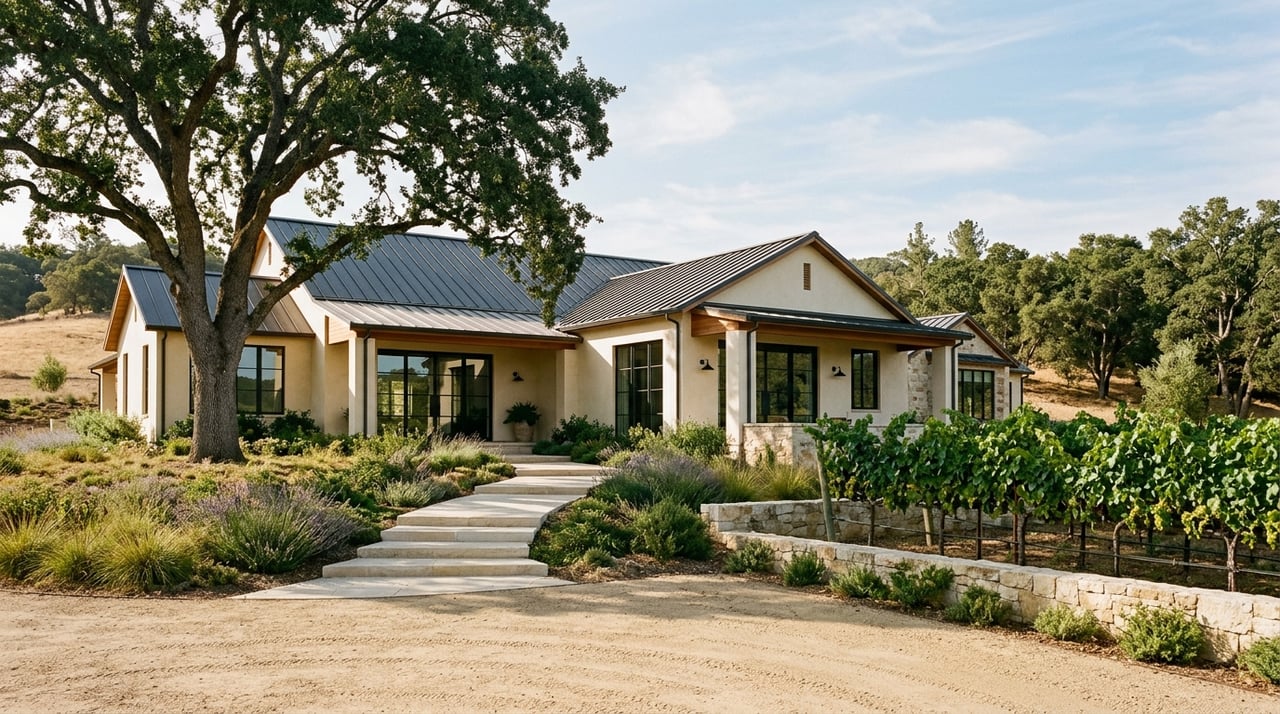
If you are drawn to Newcastle for space, privacy, and a foothill setting, acreage and estate properties can offer a lot to love. They can also come with more moving parts than a typical suburban purchase, from access and zoning to wells, septic, and wildfire preparation. The good news is that with the right questions, you can evaluate these properties with much more confidence. Let’s dive in.
Why Newcastle acreage feels different
Newcastle is not just another low-density suburb. It sits within Placer County’s Newcastle/Ophir General Plan area, which was created to help maintain rural character while allowing limited large-lot residential development and commercial growth that supports residents. The plan area covers about 5,455 acres, which helps explain why Newcastle still feels more foothill and land-oriented than many nearby markets.
That larger planning context matters when you start comparing homes. In Newcastle, “estate property” can mean a custom home on usable land, a house with agricultural zoning, or even a parcel with future improvement potential. You are often buying more than square footage alone.
Newcastle zoning affects acreage value
One of the biggest mistakes buyers make is assuming lot size tells the full story. In Placer County, zoning and minimum building-site standards can matter just as much, and sometimes more, than the number of acres shown in a listing.
For example, the County defines RA, or Residential-Agricultural, as a single-family and agricultural district. It also uses the -B combining district to set minimum building-site sizes. A label like RA-B-100 means a minimum building site of 100,000 square feet, or about 2.3 acres.
That is important because two properties with similar acreage may not offer the same flexibility. If you are thinking about future additions, a guest house, a shop, or long-term land value, you need to understand the legal framework behind the parcel, not just the marketing description.
Newcastle inventory can vary widely
Newcastle’s current land inventory shows how broad this category can be. Recent listings have included parcels described as gated property, possible lot split opportunities, and lots as large as 17.3 acres. That means your search may include everything from finished estate homes to raw land with development questions still to answer.
This is one reason acreage shopping in Newcastle takes a more strategic approach. A beautiful property may still need careful review if the access is complex, the topography limits usability, or the utility setup does not fit your future plans.
How Newcastle compares with Loomis and Granite Bay
If you are also considering Loomis or Granite Bay, Newcastle often sits in an interesting middle position. On a recent snapshot of land-only listings, Newcastle had 5 land listings with a median listing price of $908K. Loomis showed 11 land listings with a median listing price of $845K, while Granite Bay had 4 land listings with a median listing price of $1.57M.
That comparison suggests Newcastle is not simply a bargain version of nearby luxury acreage markets. Instead, it appears to offer a different mix of parcel size, utility access, improvement level, and foothill setting. Inventory is also thin across all three markets, which means each property can be highly individual.
The broader all-home market shows a similar price spread. Redfin reports a current median sale price of $529K in Newcastle, compared with $815K in Loomis and $1.415M in Granite Bay. While that is not a direct estate-property comparison, it reinforces that Newcastle occupies its own lane in the local market.
Start with legal access
For acreage properties, access should be one of your first checkpoints. Placer County notes that Assessor maps are for assessment purposes and may not match the legal lot. Legal lot information comes from recorded maps or deeds through the County Recorder’s Office.
That distinction matters more than many buyers realize. A parcel may look straightforward online, but the legal access rights, easements, and lot status still need to be verified through recorded documents.
You should also confirm whether the road is county maintained or private. Placer County makes clear that private roads are not county maintained. If a property depends on a private or shared road, you will want to know who maintains it, whether there is a recorded easement, and whether a road-maintenance agreement exists.
Questions to ask about access
- Is the road county maintained, private, or shared?
- Is there a recorded easement for access?
- Does a road-maintenance agreement exist?
- Is the driveway arrangement documented and clear?
- Are there any seasonal access concerns for the property?
Check utility realities early
Acreage homes often depend on private systems, and those systems deserve close review. If public sewer is not available, Placer County says a homeowner will need a septic system. The County also notes that soils testing may be required before a site can be developed.
Septic planning can affect more than just the existing home. The County says septic siting must account for a repair area, neighboring wells, setbacks, and the location of the tank and leach field. If you are considering additions, a guest house, a pool, a pond, or another driveway, those changes may trigger septic review or modification.
Private wells need their own due diligence. The California State Water Resources Control Board says domestic well water is privately used and not regulated like a public drinking water system, which places responsibility on the well owner. The Board recommends annual well-water testing.
Questions to ask about wells and septic
- How old are the well and pump?
- Are recent water quality test results available?
- What is the well’s flow and recovery history?
- Has the property experienced drought-related water issues?
- What is the age and permit history of the septic system?
- Is there a designated septic repair area?
- Could your future plans trigger septic changes or permitting?
Understand site work and permitting
Many acreage buyers imagine improving the land after closing. That may include widening a driveway, adding a gate, trenching utilities, or installing a culvert. In Placer County, an encroachment permit is required for work within a county-maintained road easement or right-of-way.
This is one of those details that can affect both budget and timing. Even simple improvements can become more involved if they touch public right-of-way areas. It is smart to identify these issues early if the property needs upgrades.
If you are thinking about future lot splits, ask that question before assuming added value. Placer County defines a minor land division as a subdivision creating four or fewer parcels, and splitability depends on minimum parcel size as well as the ability to support potable water and sewage disposal. In other words, acreage alone does not guarantee future division potential.
Plan for wildfire readiness
In Newcastle’s foothill setting, wildfire preparation is part of ownership. CAL FIRE says homeowners need 100 feet of defensible space around structures, with the first 5 feet treated as a special Zone 0 area in the newer defensible-space framework. Placer County also emphasizes that this buffer is important for home survival and firefighter access.
For you as a buyer, this is both a safety issue and a budgeting issue. Vegetation management, tree work, and home-hardening updates may be ongoing parts of ownership. A property that feels peaceful and wooded can also come with meaningful maintenance needs.
Budget for the real cost of acreage ownership
Acreage living often includes costs that are easy to underestimate at first glance. Beyond the purchase price, you may need to plan for driveway upkeep, drainage management, irrigation, fence repair, tree work, defensible space, and well or septic service.
Placer County’s drainage and defensible-space guidance make clear that runoff, vegetation, and site conditions all affect long-term ownership. That does not make acreage a poor choice. It simply means the right property is one that fits both your goals and your willingness to manage the land.
How to compare Newcastle acreage wisely
When you compare properties in Newcastle, focus on parcel quality rather than acreage alone. A larger lot is not automatically more useful or more valuable if access is difficult, slopes limit usability, or utilities create constraints.
In practical terms, some of the most important value drivers may include:
- Clear and reliable access
- Usable topography
- Well and septic functionality
- Defensible space potential
- Zoning that supports your intended use
- Improvement level and maintenance demands
This is where local market guidance matters. In a thin-inventory market, estate and acreage properties rarely fit into a simple price-per-acre formula. The better approach is to evaluate how each property functions in real life and how well it supports your long-term plans.
A smart buyer’s Newcastle checklist
If you want a practical starting point, use this shortlist when reviewing acreage and estate opportunities in Newcastle:
- Verify the legal lot through recorded maps or deeds
- Confirm whether access is public, private, or shared
- Review any easements and road-maintenance agreements
- Understand the property’s zoning and minimum building-site standards
- Ask whether the parcel is actually splitable under County rules
- Review well age, testing, flow, and pump history
- Review septic age, permit history, and repair-area requirements
- Ask whether your planned improvements could trigger septic review
- Identify any right-of-way work that may require an encroachment permit
- Budget for defensible space and regular land maintenance
Buying acreage in Newcastle can be incredibly rewarding when the property matches your lifestyle and your long-term goals. The key is to look beyond the charm of open land and evaluate the practical details that shape value, usability, and ownership experience. If you want clear guidance on Newcastle acreage, estate homes, or land opportunities in Placer County, connect with Samantha Gray for strategic, local insight.
FAQs
What makes Newcastle acreage properties different from suburban homes?
- Newcastle acreage properties are shaped by rural planning, larger lots, and factors like access, zoning, wells, septic systems, and wildfire preparation that usually require more due diligence than a typical suburban purchase.
What does RA-B-100 zoning mean in Newcastle?
- In Placer County, RA is a Residential-Agricultural district, and RA-B-100 indicates a minimum building site of 100,000 square feet, or about 2.3 acres.
What should you verify about road access for a Newcastle acreage property?
- You should verify whether the road is county maintained, private, or shared, and confirm any recorded easements, driveway documentation, and road-maintenance agreements.
What utility questions matter most for Newcastle estate properties?
- The most important questions usually involve whether the property uses a well or septic system, the age and history of those systems, recent water testing, septic permit history, and whether future improvements could require changes.
Can a Newcastle acreage parcel be split in the future?
- Maybe, but not automatically. In Placer County, splitability depends on minimum parcel size and the ability to support potable water and sewage disposal, so it should be verified before you rely on it.
Why is defensible space important for Newcastle properties?
- Defensible space is important because CAL FIRE requires 100 feet around structures, with special attention to the first 5 feet, and this work supports both home safety and firefighter access.